Author: Julie
How many ships have you sunk?
Yes, you did read that correctly!
When I worked as a Director of HR in the Education Sector, it won’t surprise you to learn that much of my job role was confidential.
I remember visiting a Headteacher, within our Trust, and when I arrived I found him in his office quietly fuming. Turns out that someone on his senior team had let the cat out the bag about a plan to restructure that ultimately would result in redundancies.
When you are privy to sensitive information, it’s important to be able to keep it confidential. Leaking it to the wider school community, as had happened here, had a significantly negative impact.
I remember him saying to me “Loose lips sink ships”. What a powerful saying and so punchy too!
Factoid; The term ‘Loose lips sink ships’ was a wartime expression meaning ‘unguarded talk may give useful information to the enemy’
It made me ponder about why some people can keep confidences while others find it nigh on impossible.
One personality type in particular falls into this latter group; The Influencer.
The Influencer Style (according to the DiSC model) likes to show that they are “in the know” when it comes to restricted information or “sexy secrets”. They are likely to tell one or two trusted friends or colleagues but will swear them to secrecy so that they can go and tell yet more people, “confidentially”!
Is this a trait you recognise in yourself or others? If you’re interested in personality styles and how we interact with each other, why not join my private (women only) Facebook group to find out more about how to unlock the people puzzle
All the best
Julie
PS. To save you searching, here’s the link to my group https://www.facebook.com/groups/thethriveloungewithjuliebrown
It sat in my hand and belted out a tune
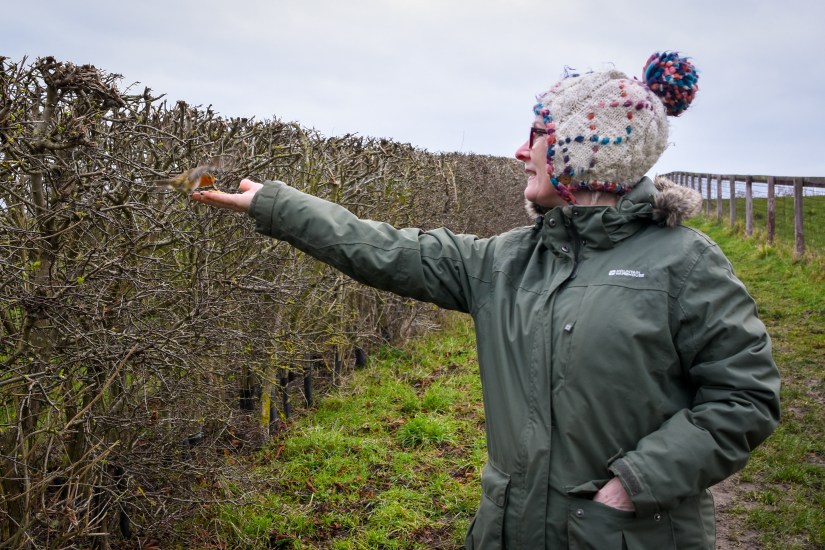
The first time I noticed it was when I was walking the dogs. It tracked me as I followed the hedge line to the woods. I didn’t stop and talk to it because I didn’t want to scare it.
Each day I began to look out for it and when it didn’t show up some days I was disappointed. Then one day I decided to take some food with me to see if it would come closer.
Gradually it got bolder and bolder until one day, when I reached into my pocket to get the bag of crumbled fat balls and mealworm, it fluttered right in front of my face as if to say “hurry up, can’t you see I’m hungry!” If you haven’t guessed it already, I’m talking about a robin!
I put the bird food on the top of a post and the robin came straight over and gobbled up it’s little treat. It wasn’t at all concerned about my two dogs hanging around.
Each day the robin would look out for me and some days when it didn’t appear immediately, I whistled for it and couldn’t believe it when it came flying over! On one particularly windy day the food I put on the post blew away before the robin had a chance to tuck in so I took some more out of the bag and that’s when it landed right on the tip of my finger! It pecked up some food and then it burst into birdsong
It went through the whole repertoire right there on my hand, looking directly at me. I could feel it’s tiny and delicate claws gripping my finger. It was simply incredible!
Three years later the robin still comes for a snack but usually only in the Winter months when “live” food is more scarce.
I count myself lucky that I get to experience nature at it’s best. This little birdie trusts me and I will not let it down.
Trust happens to be one of the highest values I hold dear. If there is no trust, there is no relationship, simple as that. What values do you hold dear?
If you want to see a picture of my robin, look below
All the best
Julie
I used to be shy….
I used to be shy.
I went to a strict all girls school in Hitchin which had it’s benefits but looking back, I think this knocked my confidence in many areas of my life. At 16 my (very strict) Dad got me a job as a Saturday girl at Woolworths as he knew one of the supervisors. I loved working there and the staff, mostly women, looked after me really well but I was painfully shy and had little confidence.
After I left school at 18 I got a job working in the civil service in the Lord Chancellor’s Department, now known as The Ministry of Justice. I hadn’t really given much thought to a career. I was greatly influenced by my family who told me that Uncle Bob had worked in the civil service and that it was a secure job with a good pension.
It was an admin job based in Hitchin County Court. I worked in all the departments, gaining knowledge and experience from how to issue a county court summons to clerking the court to managing divorce casework. I hadn’t realised how much I had learned until a new person was taken on and I was asked to train her. I was praised for my ability, something I wasn’t used to but it sprouted a little seed of confidence and for the first time in my life I began to think that I might have some potential. The Chief Clerk saw something in me and gave me encouragement to try for promotion. I was successful and this opened up some great opportunities. I also learned that praise and trust were extremely powerful motivators.
I transferred to a project management role near Holborn, managing building and maintenance projects for crown and county courts in London. I was by this time, a senior manager and as such I was put on a leadership programme that included MBTI and 360 degree feedback. This was a turning point in my life. I realised that I had a natural gift with people but learning more about personality types and behaviours was a revelation.
I embraced this new learning and applied it at every opportunity at work and home and began to see some remarkable results. I found that I was able to build rapport very quickly with people with whom I previously had not been naturally drawn to or didn’t know at all. I was able to communicate with people on a much deeper level in their preferred communication style which resulted in them going the extra mile for me, upping their commitment and loyalty.
I built and maintained strong teams and role modelled all the leadership skills that I had picked up over the years. After all that I had achieved I still doubted my ability at times, which I think is natural.
When I left the civil service to go into the education sector, out of the woodwork, colleagues sent me messages or called me to say what a massively positive impact I had had on their lives and careers. I remember one young woman in particular who told me that she would never had achieved all that she had done if it hadn’t been for my influence in her life, the support and encouragement and the special relationship she had felt. I was humbled by it.
Personality profiling has underpinned all that I have achieved and I have gone on to become an expert in personality profiling using the DiSC model which I love. I have a passion for people. I am genuinely interested in people, all people and find immense pleasure and reward when I help managers and senior managers find solutions to people problems or want to build, motivate and retain outstanding teams.
It’s all about the people.
I am no longer shy…………..but have my moments.
How to rise to the challenges of change – going back to work after Lockdown
Whilst some folk have adjusted very quickly to working from home or being furloughed during lockdown, others are only just coming to terms with this new normal when once again we are on the brink of another set of changes. We don’t know yet what those changes will be but we do know that ultimately employees need to be able to return to work to be able to keep the show on the road to enable businesses to begin to bounce back from the effects that lockdown has had.
Many will revert back to former routines with ease, maybe with some adaptations as a result of learning new ways of working from our recent experiences, while others will feel stressed, fearful and anxious. If this is how you feel, what can you do to optimise the transition for positive outcomes?
Think about it as a goal. imagine being back at work and everything is working out for you. What do you see? What does your office set up look like? What positive changes have been made to help people return safely? Who is there with you? How do you feel about seeing your work colleagues again? Where is your work station and what does it look like? What is on your desk? Spend time thoroughly playing out in your imagination a successful return to work.
If being back at work is a 10, how ready do you feel now, out of 10? What have you already done in preparation for returning? Who are you in contact with at work? What work are you still doing at home, if any? There will be things with which you are familiar, such as the nature of the work, your relationship with colleagues, the routines you have developed in getting ready for work and the commute to and from work. Think about all the positives of being back at work such as access to technology, equipment, your team and work colleagues etc.
Think about what is concerning you about returning to work and write it down. Of the list you have made, what is within your control to influence and what is outside your control? What actions need to be taken to take you 1 step closer to being ready to go back to work? Who could you speak to about them? Connect and talk to your work colleagues. What ideas can you all come up with to ease the transition to return to work safely? Talking to others and keeping channels of communication open will help you to feel included and “in it together”. Who else needs to know how you are feeling? When we get stressed or anxious, there is a temptation to withdraw so it’s incredibly important to reach out so that you can get support and reassurance.
Once you have your list of actions to take, go through the list and put a timescale to each action. Be realistic about what you know you can achieve. You may have things going on at home that might slow your progress. As you complete your list of actions, tick them off one by one to show what progress you have made. Reward yourself for getting the actions completed.
Employers have a duty of care of all employees so will be working hard to make sure that staff can return to work safely and in a timely manner. If you have any concerns, raise them. If you have ideas that will help, raise them. Be prepared to take one day at a time and readjust processes and procedures as employees and employers learn to navigate life after lockdown.
If you would like to talk through your concerns and would like help in planning for your return to work, get in touch here
 Julie Brown Wellness at The Garden Studio